leadership dot #2258: recharged

I talked to an introvert today and asked how she was doing. “Fantastic!” was her answer. “I am so recharged!”

It turns out that she had a few days at home – alone – without her kids or partner for the first time in ages and it had done wonders for her spirit.

I think that introverts need to be truly alone to fully recharge. Time with others around – even 1:1 with someone special – is like recharging a phone in the car or through a portable battery. It works, but not as well as when it is plugged into the wall.

If you are an introvert, make arrangements so that you have some time truly alone on occasion. When I was working outside the home I spent my Thanksgivings in a three-day retreat of solitude. I needed that time to get through the end of the semester and the holidays, and even though I took a lot of grief for passing on the family holidays and friends’ feasts, I treasured every moment of that respite.

If you are an extrovert, do your introvert loved ones a favor and leave them alone for a few days – go out of town with your friends (and take the kids if you have them!).  Everyone is much better off when the emotional batteries are fully recharged.

leadership dot #2257: #1

The coach of a new football team was asked to donate an item for a fundraising auction. He contributed the team’s jersey with the Number 1 on it.  “No one on my team wears #1,” Coach Regalado is reported to have said.

In that small action, the coach shared more about his values and team philosophy than could be captured in an entire playbook.

Are your behaviors consistent with the culture you are trying to create? Take a lesson from this coach and deploy small actions to create a big impact.

leadership dot #2256: do-gooder

While the Gateway Arch is taken for granted today, it would likely not have been there at all had it not been for Luther Ely Smith. Mr. Smith had the idea to do a monument to the westward expansion as a way to revitalize St. Louis. He chaired the civic committee to promote it for 15 years, oversaw the design competition and donated large sums of his own money to see the project become a reality. From the 1930s when he first had the idea until his death in 1951, Smith was a champion for a larger cause that he would never live to see.

His contribution was recently recognized by the naming of the new green space that leads up to the Arch as the Luther Ely Smith Square. I am glad that his efforts were not forgotten or his contributions lost over time.

Smith was a “self-proclaimed do-gooder.” What a great label to give yourself!

He left a legacy of improvements all throughout the city that have lived on for decades after his passing. How can you become a self-proclaimed do-gooder starting today? Even if your dreams aren’t as lofty as Smith’s the world can benefit from your efforts.

Luther Ely Smith Square


leadership dot #2255: background

I wonder how many pictures have been taken of the Gateway Arch. I know I personally have shot hundreds of them as a visitor and as a St. Louis resident, and judging by the amount of photography that was occurring while I was there in July, I am not the only one who attempts to capture its grandeur in an image (although I failed).

As I was reviewing my pictures, I noticed all the people who were in the background. I wonder how many pictures I am in – taken by strangers, who do not even notice that I am even in the frame. Yet, our paths obviously crossed, even though I have been relegated to being invisible in their photos.

I think of other “people in the background” of our lives who go unrecognized but whose work intersects with our experiences. The baggage handler who loads our suitcase on the plane or the controller in the tower who guides the pilot to the correct runway. The stocker who ensures that our groceries are on the shelf or the truck driver who delivers the goods. The maintenance person who keeps our office or school tidy or the engineer who oversees the electrical grid. We may not notice that they are there, but we would be impacted if they were not.

Retrain your eye to increase your consciousness of the whole picture. Don’t just focus on the Arch and ignore the people around it. Your life is more interconnected than you notice.

leadership dot #2254: last leg

When I was touring the Old Courthouse in St. Louis (now a museum), I came across a pile of boxes pushed off to the side of an exhibit. One was open, so, being the marketing geek that I am, I will admit that I peeked into the Federal property to see their latest National Park Service campaign.

What I found wasn’t their newest marketing efforts, rather a previous one. The thought, expense and effort that went into it were all wasted as it sat, nearly untouched, in the corner. The planners had presumably done due diligence on the front end but failed to get buy-in from those who would actually implement it.

How many times have we each been guilty of doing the same thing? Administrators create a sensible new policy but don’t share the rationale with those on the front end. Product developers create the latest new gadget without asking targeted users whether it meets their needs. Politicians enact new regulations without understanding the impact on those who must follow them.

Don’t stop short when you are doing your planning. Handing off the baton is not enough; you must stay engaged in both strategy and implementation until the finish line, not just until completing your leg of the run.

I

leadership dot #2253: elephant

One of my favorite landmarks in St. Louis is the Eads Bridge. Built in 1874, it is an intricate structure that was one of the first steel bridges in the United States. It is much more beautiful than the concrete giants that span the Mississippi now, and at the time it was considered revolutionary…

…but the structural stability of steel was severely doubted. No one had ever seen a bridge built in quite this fashion and there were predictions that it would fall into the river when the first load of cargo crossed it.

To allay his detractors, designer and builder James Eads staged an elaborate grand opening where 14 locomotives and a real elephant crossed the bridge first. Not only did they make it safely, but the bridge is still operational today, almost 150 years later.

Eads could have performed stress tests or shared loads of data with the public, but nothing would have made the same impression that a live elephant did. While an elephant actually “only” weighs about 10,000 pounds, it is perceived as a giant. The elephant was the visual that made the safety real.


The next time you need to convince doubters or establish credibility for one of your projects, don’t forget about the elephant. The impact of visuals stomps all over the impact of data any day.

leadership dot #2252: parkway

The Gateway Arch (now the Gateway Arch National Park and not just a National Monument!) recently received a $380 million renovation to the interior, infrastructure and grounds. I was quite impressed with the outcome of the whole project, but my favorite part was that they hid the nearby interstate.

I-44 runs through St. Louis and crosses very close to the Arch grounds. Previously, the pedestrian crossing was treacherous, and the magnificent Arch was disconnected from the heart of the city. You can’t really realize the grandeur of the Arch unless you are right next to its imposing size, and thousands of visitors to the Cardinals stadium, convention center, etc. never made it that close. Now, the Arch grounds seamlessly flow into a park that connects with the Old Courthouse (another monument and the site of the Dred Scott trial) and not just allows but invites, people to walk closer. Hooray!

The park renovation could have focused solely on the building and inside elements, but someone wisely dedicated resources to the exterior as well. Take a look around your building. Do you have the equivalent of a functional yet unwieldy crossing? Are you sending mixed signals to your clients that simultaneously indicate welcoming and aloofness? Should you create your own version of a parkway to create cohesion of your overall story? The physical environment around your organization sets the tone and is a legitimate part of your brand story. Don’t focus just on the forest and forget about the trees.

Interstate 44 is directly behind these trees — but you can’t see it or even hear it now

leadership dot #2251: bedrock

One of the displays at the Arch highlighted that “hundreds of lightning bolts strike the Arch each year.” Instead of that causing a problem, engineers planned for such occurrences and attached a series of lightning rods on the top of the Arch and grounded them in bedrock so no adverse effects were created by the storms.

What is the equivalent of lightning in your organization? Maybe you need to create “lightning rods” to absorb seasonal fluctuations in revenue. Perhaps your lightning takes the form of unexpected transportation delays and you need to have alternatives on standby. Or your lightning could come from external policy proposals that require you to have good community connections as shock absorbers.

Just as lightning frequently strikes the Arch, the atmosphere of your organization will be hit with random disruptive shocks. Best to place your lightning rods into your bedrock in advance.

leadership dot #2250: sensory

The Museum of Westward Expansion that is underneath the Gateway Arch was totally redone as part of the park’s renovation. Even though the subject matter did not change, there were no new artifacts to add to the collection and the location was still the same, it was a striking example of how much museums have improved in the last few decades. The museum has become a sensory experience for everyone, not just those able to read.

All throughout the museum, there are aids to make the visit interactive and tactile. An “orientation hub” provides a scale model so that people can get their bearings and blind visitors can feel the size and shape of the layout. (For example, to help illustrate the massiveness of the Arch, a school bus is scaled next to it.) Exhibits have models where air puffs come out to allow the visually impaired to follow along with what is being described. Sound recordings bring interviews and displays to life. Braille and large print text flyers are provided in each area. Music, sounds of the river and other audio enhancements fill the area. A scale model of a boat allows visitors to climb in it and have their picture taken as if on Lewis and Clark’s journey.

Think of what you can do to make your office space or organization’s environment into a sensory experience. Can you add audio from your leadership instead of just a 2D photo or bring your strategic plan to life by having the leader describe in on a video clip that shows in your lobby? Maybe you could add dimensional visuals that orient your visitors to the whole campus or complex. Or perhaps could you develop a recording of sounds that are intentional for your space instead of generic.

Go beyond accommodation and embrace sensory enhancements that bring your organization to life for everyone.

leadership dot #2249: axed

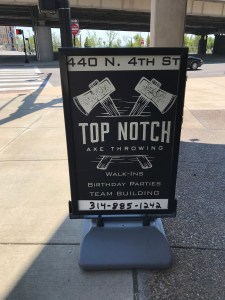
I have seen a lot of unusual team-building activities in my day, but this was a new one to me: axe-throwing seems to be an actual thing! In little areas reminiscent of batting cages, participants throw an honest-to-goodness real axe at the wall in hopes of hitting near a target (and not the person throwing next to them!).

When I saw the first facility, I thought it was a fluke, but there were at least two locations in downtown St. Louis that offer the experience. It is billed as a “corporate team-builder” although I can see many subliminal emotions that could be expressed by people’s inner Paul Bunyan.

When you are choosing a team builder for your organization, take into account the temperament and characteristics of those in your group. Some may love the physical challenge of axe throwing, while others may be more suited to the mental stimulation of an escape room or scavenger hunt. It’s one thing to take your team outside its comfort level and another push the boundaries so far that it does more harm than good. Assess whether you would want to ax this activity for your organization or determine that it could be ax-actly what your team needs!