leadership dot #2135: integration

I bought a new computer and was so excited when it arrived yesterday. When I took it out of the box, it struck me that the hardware itself is nothing without the software to run it.

The impact of components beyond the hardware even more apparent when I had my first conference call on my shiny new machine. Even though the most up-to-date software was installed on a brand-new computer at the particular moment of my call, the internet connection was unstable. Thus, my picture only transmitted as a static shot, not video, and my voice kept cutting out for them. Grr!!!

Think about the equivalent of the hardware/software/connection in your organization. You need doctors, nurses and administrators to run a hospital. You need faculty, professional staff and support staff to run a college. You need management, front-line workers and facilities staff to operate a plant. The spotlight may be on the doctors/faculty/managers, but none of it works without the other components working well.

We often forget about the support in the background and focus instead on only one aspect of the operation, but it is actually the integration of elements that creates the power.

leadership dot #2134: different

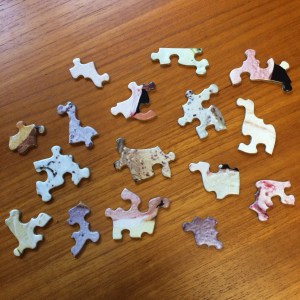
Puzzle pieces are a common analogy used when talking about fit – different shapes need to link together to form a whole, a missing piece is noticeable, everyone needs to work together to fulfill the vision, etc. But what about when the pieces are not standard shapes and challenge our perspective of what will fit together?

I thought of this when working on a puzzle that had the most non-traditional shaped pieces that I have seen. It stretched my imagination and ingenuity to blend these pieces into the picture, but, of course, they were necessary to complete it. The same can be true when talking about people instead of pieces.

Think about where you fit on the tolerance scale. Are you only comfortable with “differences” that are of the standard variety or are you able to embrace those which are outside your usual experiences? How can you intentionally seek out pieces that are more varied and come to appreciate the richness they bring to your puzzle? Can you learn to see puzzles as coming in a multitude of shapes and avoid the traditional/non-traditional labels?

It may not feel like it initially, but even shapes that you have not worked with before still fit side by side with your common variations and are the only way to make your picture complete.

leadership dot #2133: scheduled

At a mall in Minnesota, they literally tore down the JC Penney anchor store to make room for a new fitness center. It is a sign of the times – not only that brick and mortar retailers are struggling – but that gyms are thriving. There seems to be one on every corner.

I don’t think that “back in the day” we had any gyms, save for a sweaty little place where weightlifters and aspiring boxers went to work out. They certainly were not for the average person.

As a kid, our exercise was sunlight-driven or when-mom-calls-you-home driven. We got our exercise through play. Now children seem to get the majority of their exercise through structured activities that are calendar-driven: when there are practices or games. Our exercise came through goofing around with kids in the neighborhood, pick-up games of basketball or kickball in the street; today it comes through sports.

I think that gyms provide that structure after high school or college when the organized athletic events end. Gyms allow exercise times to continue to be scheduled – through classes at the gym or appointments with a trainer — and keep “exercise” as a defined event rather than an outcome of other activity.

Think about how your calendar dependency has evolved. Are there things besides exercise that need to be scheduled on it – time for friends, time to be alone, time to read or meditate? Do you need to self-impose a membership plan (like at a gym) where you make that commitment to do an activity that you know is good for you? Very little “just happens” anymore; we don’t just go out and play. Reserve time on your calendar for the things that are important.


leadership dot #2132: confirmation

I was watching some of the Senate committee confirmation hearings for Mike Pompeo as Secretary of State. Politics aside, what a grueling way to acquire a job! The confirmation hearings resemble more of a dissertation defense than an interview.

I thought about the interviews that I have been in and those that I have conducted and wondered what would have been different if I knew they were being conducted on national television. Would I have grilled the candidate in depth about philosophy, methods and past actions? Would I have paid more attention to how I came across as much as I did to the qualifications and of the one being interviewed? Would chemistry even be an issue?

Understandably, the job of Secretary of State is vastly more complex and important than any position for which I have interviewed, but I still think that there are lessons involved for the interviews you do conduct. It is fair to ask a candidate to come prepared and to talk about specific situations. It is ok to ask the hard questions and really probe in depth about past experiences. It is appropriate to ask about philosophy and rationale that would be used to make future decisions. It is an expectation that the interviewer does his/her homework too and ask specifics about each candidate rather than general, generic questions.

Come to your next interview as prepared as if you were conducting a confirmation hearing on television but take advantage of the intimacy of your private setting to assess fit with you and your culture.

leadership dot #2131: reprieve

There was one beautiful day last week where we were able to enjoy spring, and then – boom — winter returned. I think that warm weather flirting with us, even just for a brief moment, has made it harder to accept the subsequent drop in temperatures and resurfacing of snow.

There are many scenarios like this where a reprieve sounds like a good idea, but in the end, makes it worse when the new condition is only temporary. While we have no control over Mother Nature, I believe that it is harder to revert back to the original state after experiencing a better one. Examples include: having the puppy sleep in bed with you forever after an alleged one-night free pass from going in the crate; straying from your diet after having “just one” sweet that you have banished; or being even more upset about the required detour after a week of a re-opened path when work temporarily shifted. It would have been easier to have the puppy sleep in the crate, stay away from all sweets, or put up with the detour on an on-going basis.

If you have an unpleasant task or situation, don’t try to make it better for a bit. If you can’t sustain the change, you’re better off staying the course until the end. The discomfort quickly becomes the norm and there is no need to go through the initial pain more than once.

leadership dot #2130: patch

Firefighters, police and military units identify themselves through the use of patches on their uniforms. I was recently at a Firefighters Museum and was able to see a display of hundreds of different patches – all in one place. Even though they all represented firefighting teams in Minnesota, they all displayed their own personality and uniqueness.

If your profession wore a patch on a uniform, what elements would you want it to convey? How could such a common identity serve to foster team pride? You don’t have to wear a literal patch to create one or to convey the intent behind it. Maybe it could be your next team builder to create one!

leadership dot #2129: tribe

Author Seth Godin has written extensively about “tribes” – gatherings of people with a common interest, no matter how narrow. The online community has proliferated tribes because of the ease of connecting with others, but it appears that gathering in-person still has its power.

In our small city in Iowa, I was surprised to see advertisements for the Psychic & Paranormal Expo. It seems like something that would occur in major cities or inspire an online-only community, but apparently, it is a larger draw than I realized. The Expo will take place in the convention center and host over 60 vendors, featuring merchandise, readings, reflexology and presentations. There will be information on ghost hunts, crystals, past lives, reiki and angels.

Recently, a friend and his family traveled to a Chicago suburb to experience a Gluten-Free Expo and learn about the foods their daughter can eat without incident. Hundreds of vendors were on hand to share recipes and samples to this subset of the population.

This summer, I am co-facilitating a workshop for new supervisors in student affairs in higher education. You would think that the topic would be too narrow to draw an audience, but both the material and interest is robust.

Think about the tribes to which you belong or to which your organization appeals. Take advantage of the opportunity to create great energy by gathering these like-minded souls in the same space (both virtual or physical).

leadership dot #2128: deception

Many people pay attention to gas prices that are posted on the giant signs at the station, but how many people pay attention to what they are really being charged at the pump? Our local Sam’s Club is notorious for posting a lower price on the sign, but actually charging a higher price. The difference is usually only a few cents per gallon, but when you multiply that by the number of gallons and the number of people who are affected, it adds up. And it happens more times than not, so it is a system error, not a one-time mistake.

I have received my refund for the difference, but never a sincere apology. I have complained to three different managers (“Oh, I did not know; we’ll fix the sign”), but it continues to happen. I have even written the state Secretary of Agriculture, which resulted in the outside sign being removed but discrepancies continue inside.

We’re talking about a half dollar per fill-up, so maybe I should not care. My time to retrieve the refund and aggravation are worth far more than that. But where do you draw the line on transgressions that you let slide and those you try to fight?

I have always said that little=big: small things add up to affect culture, the environment, energy and change. You can’t make an issue out of everything, but if no one speaks up there is no incentive for violators to make things better.

In the words of the Civil Rights movement: “If not now, when?” “If not me, who?” Gas price deception is my issue de jour. What little improvement can be yours?

leadership dot #2127: negative

The irrational side of us wants to avoid learning information that we suspect will be negative. We don’t get our cholesterol checked because we fear that the numbers will be high. We pile up the bills instead of opening them if we worry that the checkbook doesn’t have enough funds to cover them. We stay off the scale rather than face the unwelcome number. We skip over that email on an unpleasant topic rather than reading it. We wait until April to look at our taxes because we dread learning how much we owe.

Ignoring unpleasant facts does not change them, rather it just depletes the time you have to remedy the situation. If you owe money, you owe it, regardless of whether you open the mail. And the sooner you know the details, the quicker you are able to make arrangements or develop options to deal with it.

Instead of speculating or avoiding negative news, embrace the knowing as a head start. You’ll have that much more time to reverse the situation if you spend your energy on the remedy instead of the avoidance.

leadership dot #2126: laddering

A helpful strategy for achieving long-term goals can be “laddering” – a technique that encourages people to focus on the next rung (or next step) in the process rather than becoming overwhelmed by the long-term goal. For example, if you wish to earn an MBA, it helps to think of applying for admission or completing one course. If you aim to start a business, maybe you can begin a side hustle or work part-time in the field first. It’s not achieving your goal, but it helps move you toward it.

Yesterday I wrote about creating arbitrary milestones, a technique that can aid in short-term motivational power. These milestones can also be used as ladder rungs to propel you toward larger targets. No one says that the steps on your journey need to be even. You can invent your own incremental measurements and have the steps as close together – or as far apart – as inspiration and circumstances allow.

While having a long-term view is helpful to create the vision, keeping your focus on just the next rung may be just what you need to get you there.