leadership dot #2125: arbitrary

It has always been common practice to take a big goal and break it down into smaller steps and technology has made it so easy to do. We measure everything these days — the number of steps you take in a day, the number of times you shop at a particular store, the number of reps during your workout – and more tracking provides greater opportunity for creating arbitrary milestones to celebrate.

In the era of computer gaming, recognition becomes even more important to do as gamers are used to achieving acknowledgment upon reaching intermediate “levels” – and soon the expectation will carry over into the workplace. As a supervisor, you can increase motivation by creating – then celebrating – interim steps on a long journey.

An example of this occurs in the St. Louis schools where the “100th Day of School” has become a big deal. There are special projects (eg: bringing in 100 items of something, writing 100 words, 100 Days t-shirts, 100 prizes, etc.). It has become so special that when two kids had to miss school that day for an out-of-town engagement, they shared their own 100 Days photo (below) on social media.

I have written before about the President’s 100 Days and the arbitrary badges provided by Fitbit, but you can make anything seem special by so declaring it, even if it has no legitimate significance. Think about the big tasks you are facing: a tax season, a new equipment installation or a road trip with the family. How can you provide demarcation for moments along the way: free lunch when the 124th return is filed, everyone does jumping jacks when the equipment is out of the box or you pull over for ice cream at the first exit after the 87th mile.

You possess the power to create something out of the ordinary at any point in a journey. Use that ability to motivate yourself and others to keep going.

Thanks, Brian!

leadership dot #2124: help

As part of the research conducted by Brene Brown, she asked managers what behaviors helped to create trust in their direct reports. If like most people, you guess that the answer is dependability or accountability or something similar, you would be incorrect.

According to Brown, the number one trust-earning behavior is asking for help.

And yet, how many of us are reluctant to do so for fear that it makes us look weak or incompetent or unable to accomplish our goals. We carry additional stress and work ridiculous hours because we can’t muster the courage it takes to perform a behavior that actually enhances our standing with our manager (as well as relieves us of some of the task burden).

Asking for help isn’t something that is limited to your boss. It creates bonds with colleagues, in family relationships, among friends and in most settings where the vulnerability and intimacy required just to ask enhances the feeling of certitude about the person. After all, you don’t ask for help from someone that you don’t trust.

Don’t suffer in silence. The next time you could use a helping hand, wave yours at someone and ask for their assistance. It could be the lifeline you need in the short-term as well as create a bond with them to serve you in the future.

leadership dot #2123: extend

Most people know the origin of the Post-it Note: a failed attempt at making a super-strong adhesive led inventor Art Fry to repurpose the substance to make bookmarks for his choir hymnal. The ability to reposition tabs without tearing the paper was appealing to him – and eventually to millions of others. 3M’s accidental product is now available in 27 sizes, 57 colors and 20 fragrances (!) and generates $1 billion in annual revenue.*

The newest incarnation of the sticky note is the Extreme version – designed to transverse from the office environment to the construction realm. Extreme notes are made to stick on irregular surfaces such as brick or wood and to be compatible in the outdoors. They are water-resistant and function in hot and cold weather. If they really work and catch on, the revenue figures could see a substantial boost.

Post-its are a classic office product. It seems natural to extend this line into shapes, colors, sizes and other variations for office or educational use, but it took some imagination (and engineering) to make a product that extends the same product into an entirely new field. The creative legacy of the brand’s formation must still be alive!

Think of the products or services that you offer. Is there a way to extend their use into a completely new arena? Is there a modification you could make that would enhance its appeal to a different audience or market? Try to run your new business development like Post-its and don’t permanently stick to one spot.

*Source: worldwatch.org

leadership dot #2122: merchandising

Disney on Ice came to our town, and even though I am childless and grandchild-less, I went to experience the Disney Magic and spectacle. I was not disappointed.

You notice the Disney difference from the second you step into the theatre. The lobby is lined with special merchandising booths and everything from sno-cones to cotton candy bags comes in a character-shaped container – and a premium price. The salespeople have their faces painted (which you can get too for a mere $16) and they wear crowns ($16) and wave laser wands (also $16 – it must be a magical price point).

But what stood out among the merchandising mania was one particular salesperson; he was masterful. He called out to everyone who went by. He ran two credit card machines simultaneously. He demonstrated his laser wands – the princess one when a little girl walked by and the Buzz Lightyear saber for the boys. For every single purchase, he asked the customer if they’d like to add a coloring book for $5. I am sure he had more sales than the other dozen clerks combined.

For Disney, merchandising isn’t an afterthought. In addition to the revenue it produces, the colorful themed booths set the tone and heighten the anticipation long before the show itself begins. The prolific clerk capitalized on this frenzy and leveraged it for increased sales.

Think of what the equivalent of merchandising is in your organization. You may not have sno-cones or princess necklaces to sell, but how are you creating an environment from the moment your customers enter and sending them home with a reminder of you?

leadership dot #2021: matrix

Brainstorming is a productive activity for generating new ideas, but it does not always lead to action. Often there are so many ideas at the conclusion of a session that it becomes overwhelming and hard to know where to begin. Adding a second step in the process can facilitate action by loosely prioritizing ideas before participants depart.

Define your topic/problem as a question: “How might we attract more youth to our business?” or “What incentives could we offer next year?”.

Begin by giving each member a small pad of sticky notes and a pen. Have them stand by a wall or piece of flip chart paper and brainstorm ideas for a set period of time – writing one idea per sticky note and saying it aloud as they write it. (This will help trigger other ideas from others in the group.)

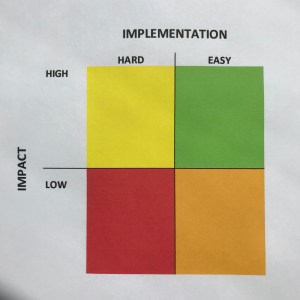
When all the ideas have been generated, on a second sheet of flip chart paper draw a grid with Implementation across the horizontal axis and Impact along the vertical axis. Create a quadrant with Hard/Easy Implementation and High/Low Impact. Then have participants place their brainstormed ideas into the appropriate quadrant.

  • Ideas that are Hard to Implement and have Low Impact (Red) can be forgotten without any discussion.
  • Ideas that are Easy to Implement and have Low Impact (Orange) can likely be set aside too. Even if they are easy, they still require some resources, and why bother if there is little to be gained.
  • Ideas that are Hard to Implement and have High Impact (Yellow) can be considered later or incorporated into more strategic planning.
  • Ideas that are Easy to Implement and have High Impact (Green) are where you should begin.

The entire brainstorming and prioritization process can happen in less than an hour but engages all the participants in both aspects of the discussion. Try it and see if it doesn’t move your ideas to action more quickly than brainstorming alone.

Download handout here.

Source: The Abel Group, Diamond Leadership Workshop, June 26, 2007

leadership dot #2120: dinner

How do you make a lasting impression on a candidate? Go meet them in person. This happened to me on this date in 2001, when my eventual boss called me up in Detroit and asked if he could meet me (for the first time) for dinner that night to talk about a job I had applied for. Impressive enough, but more so given that he lived in St. Louis.

Keith flew up to the Motor City, we had dinner, and the rest, as they say, is history. Sure, I went through the obligatory campus interview and did all the other standard things in the hiring process, but that day was when the real decision was made.

Keith said all the finalists had the right qualifications, but at this stage, it all came down to chemistry. Was I a fit with him and vice versa? The only way to tell is to spend time together in person. He invested time on the front end, and the fit was so good that we still talk every year on April 5, even though he has long retired and it is 17 years later.

Maybe you aren’t as fortunate as Keith to have the ability to go to dinner on the home turf of all your candidates, but you do have the option to spend time alone with them when they come to interview or to have multiple conversations before a hiring decision is made.

You don’t marry someone after the first date, even if you like them. One quick Q and A with someone isn’t enough to know whether the hiring match is right either.

(he forgot his business cards so wrote his contact info on his boarding pass!)

leadership dot #2119: yes, period

There will always be more to do. More that you could have done, and maybe even more that you should have done.

Those with the most balance in their lives are the ones who can take a moment to appreciate what they DID do.

We are all guilty of saying statements like: “I completed this task, and now I can do another.” Or “I did this, but it could have been better.” Yes, both may be true, but where is the recognition for what you did do?

I would encourage you personally, and certainly if you are the leader of a team, to be able to say “Yes!” – just “yes” and let that be enough for the moment. Celebrate yes, period, as a way of building up the energy to allow you to move forward and do that ‘more’.


leadership dot #2118: bridge

Part of my construction detour involves back roads with a one-lane bridge. I imagine that the bridge was initially installed for tractors or even horses with buggies and no one has felt it warranted the expense of upgrading it after all these years.

Bridges are the trickiest part of building a road. They cost the most to construct and present the greatest design challenges for engineers as it is difficult to span a gap and create a seamless interface with two opposing sides.

I think the same is true in organizations. Bridge-building among colleagues is often the most stressful and time-consuming part of a task. Creating relationships when there are opposing views necessitates delicate maneuvering and often requires great energy and patience. But just as a highway bridge can save miles of driving, a solid work connection can make things much easier on the organizational journey.

Building a one-lane bridge is an economical solution for a low traffic road, but it doesn’t work for organizations. Bridges need to allow for two-way communication and mutual understanding. On-going attention must be paid to ensure their stability.

Think about the organizational road on which you are traveling. Does it have a modern bridge, a one-lane crossing or are you just staying on your own side without reaching out to others? Bridge building may not be easy, but the benefits of a two-lane exchange span the entire organization.

leadership dot #2117: detour

Due to road construction by my house, I must endure a five-mile detour every time I go anywhere for the next three months. The alternate route takes me around to access the city from a different direction than I normally use so I have been relying more on GPS to navigate my trips.

For the past several destinations, I have pondered whether I should go via Route A or Route B and decided to check the Maps app to provide the answer. What I have learned is that there is no appreciable difference. On several occasions, both Route A and Route B have plotted out at the same amount of time, and even Route C may be just a minute or two longer.

I think we spend a lot of time and create undue stress for ourselves by debating over things that do not matter. Seth Godin recently wrote: “Choices don’t have to be decisions.”

Or, as my mom used to say: “Six of one, half a dozen of the other.”

If the difference in your choice is negligible, do not spend any of your energy making the decision. Save your brain power for where there is a perceptible difference to be made.

leadership dot #2116: pairing

The commercial side of Easter highlights bunnies, colored eggs, baskets and candy. What an odd combination. If you were starting out from scratch, you would not put bunnies and eggs together. You would not have a rabbit deliver chocolate versions of its likeness to be devoured by children. You would not add dyes to a natural food and hide them outside. None of it makes logical sense and sounds more like an April Fool’s joke than a widely-accepted practice.

And yet, in homes across the country today, there is a prevalence of chocolate rabbits, egg hunts and baskets of candy allegedly delivered by bunnies that walk on their hind legs.

It reminds me of a creative thinking exercise that asks participants to pair unlikely items together and see what new combination they form. Teams draw from a stack of index cards with adjectives and a stack of cards with nouns and see what ideas the pairing stimulates. What does a Happy Toaster look like? How about a Clean Chair? Or what about an Eccentric Shoe?

Try it for yourself and see if you stumble upon a winning combination like Chocolate-filled Rabbits or Multi-colored eggs!

Happy Easter!