leadership dot #1968: standard

I am a typography nerd, so when I discovered the link to the New York City Transit Authority Graphics Standards Manual, I reveled in the opportunity to see some of the iconic pages online (it is also now a book). The signage standards were first designed in 1970, and the strict adherence to them has made them one of NYC’s most famous landmarks.

Determining a font style, kerning and color palette does not seem like sexy work, but it is through the consistency of application that the subway signs have become art. There is no variance is what is acceptable and this repetition makes them memorable.

Those who write standards manuals and enforce the application of them are often seen as nitpickers. I remember supporting the graphic designer who reprinted an entire order of notecards because the color was slightly off. Others wanted to keep them and “use them internally” but we recycled the whole lot. I am sure the NYC subway folks would have done the same.

There is a dual meaning to “standard” – and creating a standards manual that you strictly follow will make your work a gold standard for others to follow.

leadership dot #1967: tendencies

Socrates said: “To know thyself is the beginning of wisdom” and even though the advice is two thousand years old, it is still valid; self-knowledge is one of the most powerful tools that you can have in your career arsenal.

I have always been fascinated with personality assessments and tools that help you gain insight into your personal preferences or styles. I look at them as mirrors, bringing into resolution an aspect of myself that I otherwise would not see. The assessments also provide me with language to describe feelings or behaviors that are so ingrained that I take for granted that everyone possesses them.

One of the newest insights has occurred through Gretchen Rubin’s Four Tendencies Quiz. The results describe how you respond to inner expectations we set for ourselves and outer expectations that others impose. Rubin outlines four frameworks for the Tendencies: Upholder (who meets both inner and outer expectations), Rebel (who resists both), Questioner (resists outer but meets inner) and Obliger (meets outer but resists inner).

You can take the free quiz here.

Having additional knowledge about yourself can help you design strategies to compensate in areas where you are challenged and to set up systems that play to your strengths. Knowing such information about your staff can also help you tailor your supervisory style to align with others’ tendencies and help everyone achieve success.

Spend a few minutes today heeding Socrates’ advice and gain some wisdom that will help change your habits.


leadership dot #1966: check out

The Delta Airlines app on my phone recently did an update and I was delighted to learn that they have eliminated the check-in process. Boarding passes will now automatically populate 24 hours before a flight, saving thousands of passengers from tracking down a computer and verifying that they will, in fact, use the non-refundable seat that they have paid hundreds of dollars to buy.

I suspect that airline check-ins have been a staple of the process since commercial flight began. I also imagine that many of those who have a seat that they don’t use still have checked in for the flight: an emergency came up at the last minute, their incoming flight was late so they missed the connection, they were held up en route or at TSA, etc.

I applaud the person who had the wisdom to question this long-standing practice and ask if the value outweighed the inconvenience to passengers. It was something that was taken for granted as part of the process that did not need to remain.

Maybe it is time for you to step back and evaluate the processes that have not been questioned for years. Tom Wujec’s How to Draw Toast may help you structure this exercise. What do you require of your clients that has outlived its usefulness: filling out forms instead of updating them to register each year? Requiring clients to show the same insurance card for each visit? Printing out pages of medication instructions for renewals?

If Delta can fly without manual check-ins, what can you do to travel lighter with your processes?

leadership dot #1965: Gen X

Generation X – those born between 1965-1979 are the middle child of current generational studies. Baby Boomers (1946-1964) are seen as passé and all the attention is on Millennials (1980-1994) or Generation Z (1995-present) instead of Gen X even though they represent over 20% of the workforce.

Generation Xers are predominately people in their 40s and were heavily influenced by the social changes that occurred during their childhood. Gen X is the first generation that grew up with technology, one of the factors that make them fans of multi-tasking.

When I first started presenting about Gen X coming to college, they were known as the “baby busters.” While I was aware that, compared to the Baby Boomers, historians labeled them as much more self-oriented and materialistic, what I saw as their key distinguishing trait was the element of choice. Gen Xers had a choice in far more categories than any generation before them: no longer were Prell and Breck the only shampoos, pink and red the only nail colors and one license plate design issued per state. Gen X had aisles full of toothpaste brands, thousands of credit card options and a proliferation of media content.

And with this choice came the desire to have it “my way,” a characteristic that earned them their negative connotations. Gen X was the first generation to be lavished with recognition and praise (making them cynical), and also the first group who wanted to postpone commitment (why decide when there are so many choices and something better may come along?!). This was the first group that grew up with both parents working, making them more independent and interested in autonomy.

Generation Xers hold many of the up-and-coming leadership roles in our organizations and society. Keep their perspective in mind if you are working with or for someone in the 38-52 age range. Provide options, independence, lots of information in little bite-sized pieces, clear procedures and praise!


leadership dot #1964: easier

A reader with a past gambling history wrote to syndicated columnist Jerry Romansky asking how to handle a night at the casino that other couples planned for the group during their vacation. His advice: “Prevention is easier than correction.”

How true it is, and not just for gambling, but for dozens of other applications:

> Maintaining a grasp on your email volume is easier when done daily rather than when your storage is full.

> Nipping a performance issue in the bud is certainly more effective than discipline down the line.

> Keeping up with preventative maintenance on your car and home is far easier than dealing with repairs.

> Tending to relationships and preventing issues from festering leads to greater satisfaction vs. counseling or shouting.

> Limiting your opponent to small gains and maintaining your lead sure beats playing catch up.

> Keeping your body at an appropriate weight is easier than trying to lose weight after gaining it.

> Spending within your means involves fewer sacrifices than trying to get out of debt.

The time and energy you spend correcting a problem are usually greater than the efforts you would have invested to avoid it. Make the hard choices in the beginning and keep your focus on the prevention side of the equation.

Source: Ask Jerry column by Jerry Romansky in the Telegraph Herald, October 15, 2017, p. 2C

leadership dot #1963: radical candor

As we commemorate Bosses Day today, I remind all bosses and aspiring bosses that one of their most important functions is to provide feedback to employees. One model that helps to frame the spectrum of feedback options was developed by Kim Scott, author of the 2017 book Radical Candor.

Kim’s premise is that for effective feedback, the person must Care Personally and Challenge Directly. If someone has accomplished both aspects, she terms their feedback as Radical Candor – where you can provide direct and helpful feedback to help the person grow.

People often Care Personally – a lot – and because of their focus on being nice, they fail to challenge directly. Kim believes this is Ruinous Empathy, luring the person into a false sense of security because they have not received the honest feedback they deserve.

The opposite extreme is Obnoxious Aggression – feedback that is given without care and thus is often ignored or seen as not helpful.

On her website (radicalcandor.com), Kim shares stories and provides many more examples of the quadrants in action, but I believe this simple diagram will provide you with some fodder to consider today.

Where do you fall on the Care Personally/Challenge Directly spectrum? Have you truly shown your employees (or colleagues, partner, children, etc.) that you care about them? Do you care enough to provide the honest feedback that they would benefit from hearing or do you avoid it to keep yourself comfortable?

We’d all be better off if we delivered feedback with Radical Candor, keeping the civility and care as part of the equation while still saying what needs to be said.

Radical Candor handout

Thanks to Meghan for connecting me with this resource!

leadership dot #1962: hello science

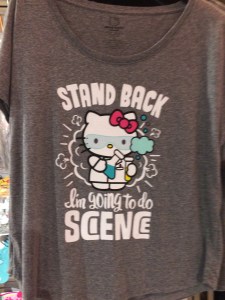
There have been many efforts to promote science and STEM education with girls, but I think that the target audience will hear the message more loudly thanks to a new partnership with Hello Kitty. The internationally famous icon has come out with a new line of products promoting science, and especially science for girls.

Hello Kitty has previously attached its brand to cosmetic lines and frilly pink items so it is delightful to see it expanding its influence in ways that could encourage young girls to explore new career areas. Even if Hello Kitty fans don’t go into science directly, prompting them to “think like a scientist” will pay dividends in all aspects of life.

Hello Kitty + science is outside their norm, but smart. How can you think beyond the obvious to identify a new spokesperson for your brand and partner with someone that makes your message purr?

leadership dot #1961: souvenir

How many times has the airport been the only place you have seen in a city? Unfortunately, for frequent travelers, it happens regularly.

Kansas City (KCI) is catering to the airport crowd by offering a vending machine that allows travelers to bring home a souvenir of a higher caliber than the typical tchotchkes sold in airport stores. Even if you never get beyond the concourse, you can purchase desirable items from their clever SouveNEAR machine. It’s like an automated Etsy store, featuring cards, shirts, journals, snacks and jewelry – but all are handmade items that are produced locally.

KCI airport has done a great job of bringing their product to potential customers. Think of how you can take advantage of the ever-expanding capabilities of vending machines to reach your clientele. Spirit wear at athletic venues? Branded merchandise for your organization at your office or events? Convention centers that rotate merchandise depending on the current show? Rain gear at outdoor public places like zoos or amusement parks? A way to sell products of students or employees?

Dorothy and Toto may not be in Kansas anymore, but the effective use of vending machines certainly is. Click your Ruby Slippers and add vending to your brand outreach.

leadership dot #1960: looking for

When you are asked to recommend something – such as a book, a restaurant or an activity – it is tempting to jump in and answer with your favorite item in that category, but that is the wrong approach.

A concierge taught me that the correct answer to such questions is: “What are you looking for?” It is simple, yet brilliant.

> If you ask: “What are you looking for?” you can learn that a person wants either a quick bite to eat or a fancy meal – so your initial thought to recommend your favorite moderate restaurant is not appropriate for either.

> Knowing that someone wants a light romance novel or a romantic comedy movie shifts you away from suggesting the 800-page Hamilton book or Hacksaw Ridge movie even though both were excellent.

> If you learn that someone wants a stylist that is quick or inexpensive, it guides your answer to become much more helpful than giving the name of a professional who is costly and meticulously slow.

Whether providing recommendations for a realtor, candidate, store, contractor or neighborhood, the answer depends significantly on what the questioner is seeking.

No matter on what topic your advice is being solicited, one simple question can provide the clarification that makes your response both relevant and responsive. To provide the best service, reply to the next query with a question instead of an answer.

leadership dot #1959: cleaning

Chihuly glass sculptures make for great art and are a visual treat for the observers, but what about the person who has to clean them? This article describes the work of glass cleaner Dave Pugh, who meticulously and cautiously takes individual pieces off the stainless steel studs, labels them, wraps them, cleans them and returns them to their original position. It is work behind-the-scenes that few consider, but is essential to the on-going enjoyment of the sculptures.

It reminded me of a photograph of the National Park Service workers who are charged with maintaining the Lincoln Memorial in Washington, DC. Twice a year they do their work in the middle of the night, cleaning areas that would entropy without attention. Cleaning the monument involves power washing, steam-cleaning, dusting and hand-finishing of the marble and takes a crew seven hours to complete.

None of the back-of-the-house jobs are glamorous, but all of them are essential. It is work that makes the front-facing elements more enjoyable and maintains the quality instead of allowing it to diminish over time.

Think about what is in your organization that should be on an annual or semi-annual cleaning schedule. Is there an exhibit that is starting to look tired or displays that could benefit from a sprucing up? Do you have furniture that is used daily in your waiting room, but no one can remember when the upholstery was last washed? Have you left all of your outside cleaning to Mother Nature instead of tending to your windows, signs and bricks?

Physical assets may be low maintenance, but nothing is no maintenance. Include some elbow grease time on your annual planning calendar to keep the sparkle in your possessions.