leadership dot #1876: calculating

My nephew is going to college to study actuarial science — the art of calculating risk — and I wish I could deploy him to give me some odds on some personal decisions instead of just having him calculate insurance rates or credit worthiness.

Lately I have been weighing the merits of several decisions that involve a host of unknowns. Should I buy that $500 generator or take the chance that the power won’t go out again and risk flooding my basement without a sump pump? Is it worth it to go through the discomfort of a colonoscopy on the chance that they will find something but risk the possibility that in the process they will tear my colon or do one of the other nasty possibilities the doctor listed in his pre-op exam? Will a business loan propel me into an exciting new venture or just rack up debt? Should I buy a $250 CUJO firewall or hope hackers don’t bother me? There is no way to have a definitive answer for any of these questions, and yet I must choose one of the options.

As you face risk questions in your own life or organization, consider not only the pros and cons of each choice, but also the implications from procrastinating or just letting fate decide. It’s also helpful to have a self-awareness of your overall tolerance for risk — if you know you are adverse, you can consciously push yourself a bit past the comfort zone, but if you tend to fly on the aggressive side, perhaps a bit of caution is warranted if you are feeling some doubt. I’m afraid that until someone starts a personal actuary service you’re on your own to determine whether to roll the dice or not.


leadership dot #1875: understanding

A carpenter friend of mine has a set of colleagues that call him to do work when the occasion warrants: putting up siding, doing a drywall project that requires heavy lifting, framing a house, etc. When a two (or more) person crew is needed, they give him a call. Curt also has “a guy” that he hires when needed, otherwise, he works solo.

The on-demand labor pool described above is pretty small, so they all use each other repeatedly. This gives everyone enough knowledge and familiarity to become immediate contributors — they know the work and each other, thus the learning curve is minimal before they can jump in and do something meaningful. Their history together makes them exponentially more valuable to each other than just any random rented laborer.

This system works well in construction, but think about how you can you adapt it to a knowledge setting as well. Office workers or entrepreneurs can hire out specific jobs, but envision crafting a way to get a pool that you can use regularly to think with you. Is there a way to create a recurring group of people that have enough of a context to make relevant contributions without spending too much time understanding your goals? Can you cultivate a pool you can call when you want to brainstorm or talk something through? How can you develop a small group of thought leaders that are available when needed to help you advance your work?

Networking events and freelancers are wonderful additions and are great for initial connections or specific tasks. But focus your energy on building those relationships that go deeper and can provide you with recurring value. Having someone who understands how you work is gold.

leadership dot #1874: essential

When visiting the office of a colleague who works in public relations, I noticed an extra sport coat, dress shirt and tie on the back of his door. I know from my previous time in working with him that this is an ubiquitous feature in his office — always at the ready to be filmed on television even if he happened to be dressing casual that day.

For Mike, a press-conference-worthy professional outfit (from the waist up which is all that is shown from behind a podium) is an essential tool for the job. He can’t take the chance that he will be in a polo if thrust into the media spotlight as a spokesperson for his organization, so the suit-on-the-door is standard.

Have you considered what tool may be essential in your position under certain circumstances and taken steps to provide duplicates that are always accessible? Maybe your necessity is a flashlight so you can immediately act if the power goes out. Maybe you require a list of codes or passwords for off-site access in an emergency. Perhaps you need a change of clothes out of your professional attire so you can become hands-on if disaster strikes. Or you may need to carry around extra batteries for your equipment or phone so that you are ready to capture that unexpected big moment. Maybe it involves having an extra blog entry “in the cloud” to access remotely if the power or computer fails.

No matter what your role, take a few moments to anticipate the “what if”. What is the most likely scenario that disrupts your normal — and then how can you take one step toward preparation for the unlikely? The answer may suit you well in unfortunate circumstances.

leadership dot #1873: circuitous path

Yesterday I wrote about my insect bite and related it to the need for organizational Benadryl. As far as the bite goes, Benadryl performed so well and so instantaneously that it got me wondering about the drug itself. Where did this miracle come from?

While I expected that it was invented by a man named Ben, its originator is actually George Rieveschal. While he was conducting academic research on muscle relaxants (not allergy inhibitors), he realized that his formula blocked Histamines and thus lessened the impact of itching and inflammation. Rieveschal pursued his research at Parke-Davis drug manufacturing, and Benadryl became available with a prescription in 1946. For his invention, he received a 5% royalty during the initial 17-year patent period, but not any income after the product became over-the-counter and reached $180 million in sales.

You might expect that Rieveschal was a medical doctor or at least had medical training. Actually, his initial degree was from the Ohio Mechanics Institute of Technology and he sought his first job in commercial art. Fortunately for those with allergies or itches, it was the Great Depression and no art jobs were to be found, so he went back to school and pursued chemistry. He was a chemical engineering professor when he made his initial discovery.

Those in higher education speak to students all the time about how a choosing a major should not be the major decision than it is made out to be. Rieveschal is a great example of a circuitous path that led to great things, and I am sure the diversity in his education aided in his research.

Regardless of what you studied or what your current career is, pursue your interests with a passion. The next miracle creation could be yours.

To learn more: George Rieveschal, 91, Allergy Reliever, Dies by Dennis Hevesi, The New York Times, September 29, 2007.

P.S. The name Benadryl comes from the technical name of the formula: beta-dimethylaminoethylbenzhydryl ether hydrochloride.


leadership dot #1872: inflamed

While outside reading, I was bitten by an insect. It was so small and fast that I did not even see it — until a spot on my hand became red. When I woke up, the whole area was inflamed, and by mid-morning I was heading to the store for Benadryl. I could concentrate on nothing else — all because of something I did not even notice initially.

Is one of your organization’s employees like that insect — stealthily spreading toxicity throughout your organization? Maybe they are not loudly protesting or causing a scene, but if they are buzzing from person to person leaving a negative reaction behind the effect is even more powerful. Others may not even realize what is causing their itch, but it is distracting them nonetheless.

As the leader, you are responsible for administering the equivalent of organizational Benadryl or deploying the swatter. Don’t let size fool you. Something so small can have a disproportionately big impact if you don’t stop it.


leadership dot #1871: repurposed

Many newly married women save their wedding dress to become a keepsake for future daughters, but in reality the dress never leaves the box. An organization has found a much better use for the beautiful garments by turning wedding dresses into Angel Gowns for babies who don’t survive their short life in the NICU. (Many other individual volunteers across the country also create memory gowns and are currently accepting donations.)

photo credit Justi Underwood Bates on Facebook

Angel dresses honor the magnitude of the moment and allow grieving parents to have a special garment for photos or funerals. Through the work of many, these babies are physically wrapped in love.

Kudos to those who saw a way to make this match by meeting a need for both parents and those who divorce or do not want to keep their dresses forever. Can you make a similar match? Think of something that you have at home or in your organization that just “sits around” and could be repurposed for a much greater value. If you look at your possessions with new eyes maybe you can see a way to give something new life in a different form.

To make a donation of a gown or funds to mail them to hospitals also see: Ansel Morris Trisha Hamor on Facebook or Jessica Heffiner at glorybabyministry@gmail.com

Thanks Meg for sharing!

leadership dot #1870: informed

It’s going to get a lot harder to use the old “check’s in the mail” excuse. The United States Post Office is launching “Informed Delivery” which provides a scan of the envelopes of all the mail I am receiving later that day. I can go to my USPS account on line and check to see what will be in the box when the carrier arrives.

Do I really need to know this? I assume that the post office is trying to accommodate the mobile lifestyles of people who can’t conveniently check their mail or who want to see if it is “worth it” to head to the box. But knowing a letter or bill or check is there does little to facilitate its processing, and heaven knows I don’t want anyone opening my mail and scanning that too. All it seems to do for me is remove the element of surprise and delight when a true handwritten letter greets me after I turn the key.

Where is that line between helpful information and overload? Think about what you provide to your customers and watch that you don’t cross it like the post office did.

leadership dot #1869: equity

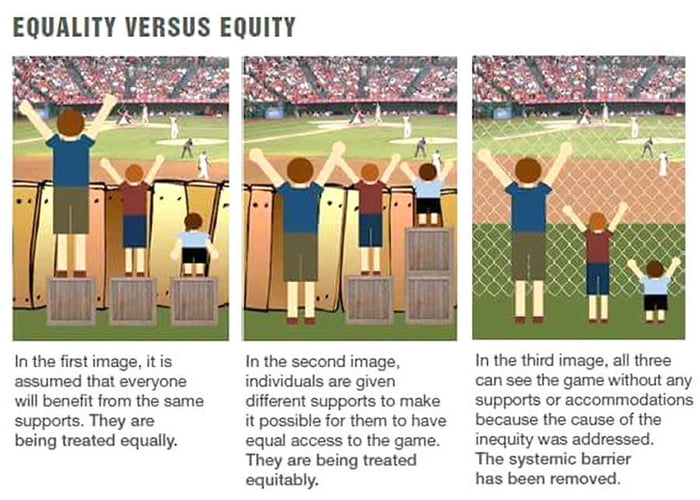
Analogies and pictures can go a long way in making a complex topic understandable. I recently came across a picture that illustrates the difference between equality versus equity in a simple three-frame drawing:

Take a moment to reflect and ask yourself how you can apply this concept. What image represents how you are you personally acting as a supervisor or a parent? Which frame best describes efforts in your organization? Is your compensation and promotion program equal or equitable? Do you focus your time on addressing the first, second or third frame?

Reality is definitely not as simple as this illustration, but picturing the goal may help your actions and your organization move closer toward attaining it.


leadership dot #1868: generator

I wrote yesterday about Farmer Herman needing help in moving his barn. I was about to solicit 344 people to help me move my house as our area was deluged with over 5 inches of rain and 75 mph winds — all in the dark as the power was out for 14 hours.

In the morning, I was one of the many at Lowes looking at generators and back up plans for a non-functioning sump pump. I asked my contractor friend why he did not already have one. His answer: “They just sit around.” The Lowes manager replied: “Yes, they sit around, until they don’t.” Like now.

What is the equivalent (or maybe even literally) the generator for your organization? Think of the report, client access information, equipment or data that is essential for your operation and how you might have a back up plan if your usual way of obtaining it is not available.

Maybe you could you print out a copy of your staff contacts instead of relying on your phone to obtain them, or send your customer database to the cloud. Another idea is to print out key data on occasion or have a copy of your key data points at home. Perhaps you could purchase a flashlight for each desk in your office or pick up an extra supply of batteries and a radio.

The question is not “if” you will need a detour, it is a matter of “when.” The time to plan for a generator is before the storm, not during it.


leadership dot #1867: move the barn

If I told you that one solution to prevent flooding in a barn would be to have a group of people move it to a new location up the hill, you may think that I was crazy. But such a feat actually happened.

In 1988, Herman and Donna Ostry’s barn was moved 115 feet to the south, up 6 feet of elevation, turned 90 degrees and set back down! It required 344 people and 20 minutes to accomplish the task.

The story has been captured in a new children’s book that is relevant to any organization trying to get a group of people together to solve a “big, big, big problem.”  Farmer Herman and the Flooding Barn shares several silly scenarios — including moving the barn up the hill — but ultimately the impossible proves to be possible with enough help.

If your organization is facing a daunting task, Farmer Herman may prove to be a valuable story to share with your group. It is short, funny and best of all, true. If their community can move a barn up the hill, what is possible with your people working together? Don’t laugh at the answer.

Farmer Herman and the Flooding Barn by Jason Weber, benefiting the National Foster Care Initiative