leadership dot #2319: resourcefulness

One of my new fall traditions to is to visit a historic barn as a way to experience the heritage of our state. The barn I saw this year was built in the 1860s, a time when any type of building was an arduous task, let alone the rigor of farming around it.

I was struck by the ingenuity used in its construction. The ceiling beams are sawed-in-half tree trunks, still covered in bark. The walls were cemented together stones. There were no finished, planed lumber planks or uniform pre-cast bricks but the farmer made do anyway – in a sturdy enough manner that it has remained for over 150 years.

It is easy to delay a project because you don’t have the proper tools or equipment. Sometimes you opt to wait until everything is “just right” before beginning. The next time you’re tempted to use this excuse, think of the historic barns and press on anyway. Achieving completion resourcefulness is better than perfection.

leadership dot #2318: boo

My sister came home to find an extensive gift basket filled with Halloween goodies on her porch – she had “been Boo-ed.” It’s a version of Secret Santa but for Halloween where neighbors anonymously deliver treats to other neighbors without getting caught. Those who have been visited post a ghost in the window so the next “phantom” knows to leave their basket at another house.

For me, it was one more sign that Halloween is taking on a life of its own. Not only is “getting Boo-ed”  happening in many communities, but there are a plethora of themed items to fill the basket that is delivered. Everywhere you go, there are more and more Halloween decorations, candies, accessories and gift items. It is becoming a major holiday on its own.

So, if you have caught the orange and black spirit and want to start a fun tradition in your neighborhood, leave someone a Boo Basket this weekend. It’s like mystery trick-or-treat for grown-ups and a fun surprise to find on your doorstep.

See more at: www.BeenBooed.com

leadership dot #2317: leaders lag

One of the jobs of the leader is to think long-term to develop strategies to affect change in the future. The leader may discuss plans with a senior circle and have many, many meetings about the idea long before it is able to become public. Because the leader spends so much time thinking about the new, she becomes accustomed to the idea and it no longer feels new to her, and therein lies the potential trap.

Unless a conscious effort is made otherwise, leaders often forget that there is a lag between when they first started thinking about an idea and when their staff or wider audience learns of the plan. The change-makers at Alia Innovations have depicted this gap in the Leaders Lag chart, illustrating that the leader is always ahead of the staff in thinking about change.

The leader has the advantage of having an extended interval of time during which they have become comfortable with the new and, to be successful, the leader must allow that adjustment period for others. The next time you are trying to impact a change, take the time gap into account. You need to synchronize in order to swim.

Thanks, Amy!

Thanks, Colleen for use of the picture!

leadership dot #2316: bring it

I recently presented at a conference where I understood that I did not need to bring handouts. “Everyone will access them on their tablet or computer or print them from the information in advance,” they said. I had to submit the handouts far in advance and the organizer commented on how they would be helpful for promotion. I thought all was good.

As you probably have already guessed, all was not well. The handouts weren’t posted in advance and so no one in the session had them. I was able to make the session intelligible by referring to the material on the PowerPoint, but it would have been much more beneficial for the participants if they had the information on hand. I will never be without them again.

It reminded me of a story I heard about the touring company of Hamilton. Apparently, they brought everything they needed with them – right down to the paper clips. I suspect that this is because of a similar situation where they needed something that they were told would be provided and it wasn’t.

I’m surprised that I didn’t bring handouts anyway because I routinely follow the scouting motto to “Be Prepared.” I bring my own whiteboard markers and eraser when I teach a class. I always have cash in case the person I’m with forgets his wallet or the establishment doesn’t take credit cards. I bring my own pillow when overnighting and I’m usually the one who has the equivalent of Hamilton’s paper clips when traveling. I come prepared!

It is easy to remember the big things, but it is often the little things that make the experience run smoothly. Think about what items add to your comfort and efficiency when you are away and take them with you. If the session doesn’t go well or the papers aren’t organized, it reflects on you more than the person who was supposed to provide the item for you.


leadership dot #2315: wasted

One of the lines from the Broadway soundtrack A Bronx Tale* states: “The saddest thing in life is wasted talent.” I agree with this premise but would add “or wasted volunteers”. There is nothing that can kill long-term motivation faster than someone offering to help and showing up only to find that there is nothing for them to do.

It happens in service organizations where people agree to assist on a project but then hear that “we’ve got this” or the project is all but finished by the time they arrive. It happens in the workplace when someone offers to take on a task but then learns that someone else decided it would be easier to do it themselves. Wasted volunteer efforts happen when plans change and the person who raised their hand is not notified, leaving them alone at the original location, or when someone volunteers to make a connection or contact but the offer is never utilized.

When someone agrees to help – in whatever form that may take – accept their willingness as the gift that it is. Just as you would never leave a present unopened or left aside, treat those who raise their hand with the same anticipation and gratitude.

*from “Look to Your Heart” on A Bronx Tale Original Broadway Cast soundtrack.

leadership dot #2314: invest

The basic premise of my dissertation was that all the literature says a) higher education needs to change and b) change happens through people – so I studied whether higher ed was formally helping its people to change. (The answer was no.)

I see a similar parallel today in my work with supervision. The research clearly says that the manager is the most important factor in employee retention and organizational productivity but are most organizations doing anything to formally train their supervisors? Again, the answer is no.

People are often promoted to supervisor because they were good at the level below that – making widgets, front-line service, serving as an assistant, etc. And yet when they get the job that involves motivating and evaluating others, they are expected to have amassed this skill on their own. People aren’t great supervisors instinctively, rather they approach it through trial and error – incorporating the things their good bosses did and trying not to replicate their bad boss’ behavior. There really is a better way.

On this Boss’ Day, do your boss and everyone they supervise a favor and dedicate resources to professional development. Allow your supervisors to have a coach as a way to talk through problems and learn from them. Allow new or prospective supervisors to attend training to gain specific skills in the supervisory area. Treat supervision as a skill that everyone needs to continually develop and grow.

Gallup says that “the effect of a great manager is the gift that keeps on giving.” Give your organization the gift of strong supervisors by explicitly nurturing this skill instead of hoping it happens by nature.

leadership dot #2313: be generous

Thanks to the magic of streaming, I’m in the middle of watching all of the old ER episodes on television. One of the series’ lead characters, Dr. Mark Green (Anthony Edwards) is dying of cancer and ponders what to tell his daughter before he passes. The advice he gave: “Be generous. Be generous with your time, be generous with your love, be generous with your life.”

It is good advice for everyone, not just from fathers on their deathbed.

Generosity can take many forms, most of which involve time instead of money. I work to be generous with materials that I have developed and know many colleagues who do the same. I have benefited from the advice others have given regarding adjusting to a new city, developing a new course or navigating technology. People have been generous in sharing their insights to help me craft many dots and even leadership dots as a company. I have shared training techniques, mentored staff and tried to be generous with lessons I have learned along the way.

One of the best ways to cultivate your own gratefulness is through generosity to others. Today, pledge to do a little more giving than taking.


leadership dot #2312: calling card

While rummaging around a flea market, I stumbled upon a basket of calling cards from the 1800’s. Apparently, most people in high society had their own printed cards that they could leave behind when they came calling as visitors. They were the personal equivalent of business cards and had a clearly personal focus. Cards were imprinted with messages such as: With love’s greetings, Far from thee be every care, All happiness to you and Forget me not. Both men and women used them.

What struck me about these cards was how beautiful they are. This was the 1800s and yet they are full-color, embossed, dimensional, with scalloped edges, die cuts or in miniature envelopes. The name is printed in elegant script behind the images. If you were to attempt to buy these today they would be prohibitively expensive.

Email and messaging apps provide wonderful efficiency and connect us with many that we would never have occasion to deliver one of these gorgeous cards in person but it makes it much more difficult for the personality of the sender to shine through. Think about what you use as your calling card – whether that be a business card, email signature, profile photos or username – and infuse it with some of the classiness and grace that was exchanged before the turn of the century.

leadership dot #2311: ill-will

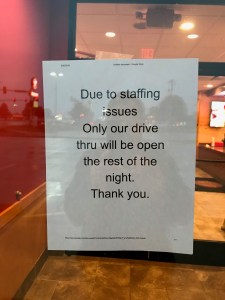
I recently attempted to eat dinner at a restaurant but was greeted with this sign on the door: “Due to staffing issues only our drive-thru will be open for the rest of the night.” Inconvenient to be sure, but I had won a prize from the restaurant that I wanted to use so back to my car I went to pull around.

At the drive-thru, I learned that the $10 gift certificate that I won from their contest was when the franchise was under a different manager and the prize would not be honored. So I moved on to Plan C, only to find my coupon didn’t work either as their “mixed chicken” did not mix chicken and tenders (which is what my friend wanted). At that point, I opted for the three-strikes-you’re-out theory and left without ordering anything.

After my experience at the drive-thru, I am not surprised that they had staffing issues or turnover in their management. If leadership doesn’t show consideration or provide good service to customers, I suspect it carries over to how they treat employees. Or maybe it is the reverse: because the management doesn’t treat employees well, maybe that is why the staff doesn’t treat customers well. Either way, it is a recipe for ill-will and operational decline. No matter how tasty the food, if the people aren’t good it doesn’t matter.


leadership dot #2310: funny money

I am always amused by the strategies people use (and the games they play with themselves) to help them manage their money.

I was recently at a flea market and paid for my item with a $5 bill. The husband rolled his eyes and said: “You had to pay with a five, didn’t you?” I learned that the wife’s strategy is to set aside all five-dollar bills from their transactions throughout the year and she uses them to buy Christmas presents.

I know of another family that allocates, in cash, a designated amount for groceries each month. At the end of the month, it feels like there is “nothing to eat”, but because the cash is running low it forces them to be more creative and make something out of the inventory on hand since going to buy more at the store isn’t an option.

When I worked on campus I still did occasional consulting gigs and always kept those earnings in a separate account. My family came to refer to it as “magic dollars” since I used it to splurge on gifts or vacations that were beyond normal operating expenses.

There are many more ways that people use to segregate funds for designated uses. It happens more formally in organizations but keeping some restricted accounts in your personal finances may make it easier to accumulate a windfall you can later spend.